
Manual operational workflows
Repetitive tasks consume time and make processes difficult to scale.
TransformingDigitally helps organisations operationalise AI across workflows, reporting, knowledge access, customer operations and enterprise decision-making.
We design and integrate secure, scalable AI solutions that reduce manual dependency, improve visibility and support faster, more informed operations.
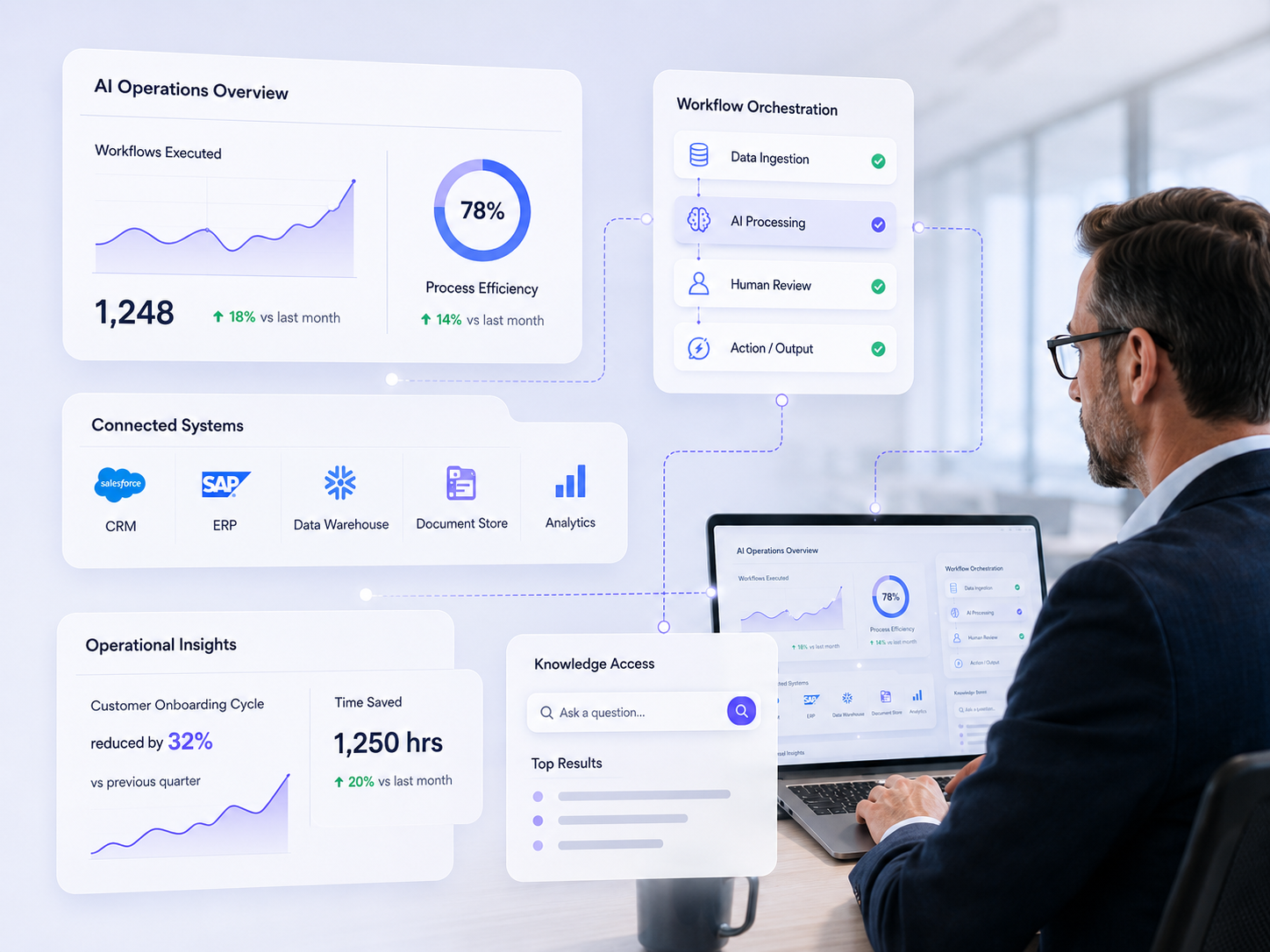
TransformingDigitally designs and deploys enterprise AI solutions that connect business workflows, data, documents and systems.
Our capabilities include AI workflow automation, enterprise knowledge platforms, AI agents and copilots, Gemini enablement, AI reporting and custom AI platform development. We help organisations move from isolated AI experiments to practical solutions embedded within everyday operations, with appropriate integration, human oversight and scalable architecture.
Automate repetitive workflows, approvals, reporting and document-heavy operations.
Search policies, documents and business records using natural language.
Deploy task-oriented assistants that support teams across operations and service functions.
Operationalise Gemini across Workspace, internal workflows and controlled business use cases.
Generate summaries, dashboards and operational insights from connected data.
Build AI-enabled platforms around specific workflows, industries and operational models.
Many organisations have experimented with AI tools but still depend on disconnected systems, manual workflows and fragmented business information.
Repetitive tasks consume time and make processes difficult to scale.
Teams spend significant effort collecting, preparing and interpreting information.
Business data remains fragmented across platforms and departments.
Leaders lack a complete and timely view of processes, performance and exceptions.
Important information is difficult to locate or arrives too late for effective decisions.
Employees spend valuable time on data entry, document handling and routine coordination.
Manual dependencies and disconnected workflows restrict growth.
Documents, emails, records and knowledge remain difficult to search and reuse.
Successful enterprise AI adoption begins by connecting technology with real workflows, reliable information and accountable human decision-making. Continue to AI as an Operational Intelligence Layer .
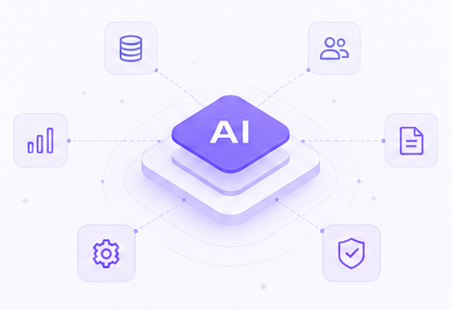
We help businesses connect AI across departments, systems and workflows so it becomes part of everyday operations—not a standalone experiment.
Our AI solutions embed intelligence into the flow of work, turning data into action and helping teams make faster, smarter and more consistent decisions at scale.
Reduce manual effort by automating high-volume, low-value tasks across workflows.
Make policies, documents and data easy to find, understand and use across teams.
Generate accurate reports faster with automated data aggregation and summarisation.
Surface real-time insights across systems to monitor performance and identify issues earlier.
Empower teams with AI copilots that assist, guide and execute context-aware actions.
Optimise processes, handoffs and approvals to reduce delays and increase throughput.
Enable faster decision-making with real-time intelligence and operational alerts.
Create resilient, AI-powered operations that scale with your business, teams and users.
Whether you are exploring workflow automation, knowledge access, reporting, AI copilots or broader operational intelligence, we can help define the most practical next step.
We focus on integrating AI into real workflows, systems and teams—so solutions are usable, governable and aligned with measurable business needs.
We embed AI into how work happens—driving adoption and real impact.
We start with outcomes, align stakeholders and prioritise what matters.
People stay in control with clear roles, review points and guardrails.
We connect relevant systems with appropriate access, privacy and controls.
We design for scale—so solutions can grow with your business, processes and teams.
We bridge business, process and technology needs to deliver solutions that work end-to-end.
We consider roles, data pathways, human checkpoints and governance from the start.
We target high-friction workflows with measurable value, clear ownership and fast feedback loops.
We support adoption, iteration and scale—so teams can continue improving after implementation.
Our delivery approach connects business goals, workflow realities, technical feasibility and human oversight.
Understand business objectives, workflows, systems, users and operational constraints.
Identify AI opportunities based on value, feasibility, risk and implementation effort.
Define workflows, data requirements, integrations, human checkpoints and success measures.
Develop the AI capability and connect it with relevant systems, data and user interfaces.
Test accuracy, usefulness, workflow fit, access controls and operational reliability.
Expand successful use cases across teams, processes and business units.
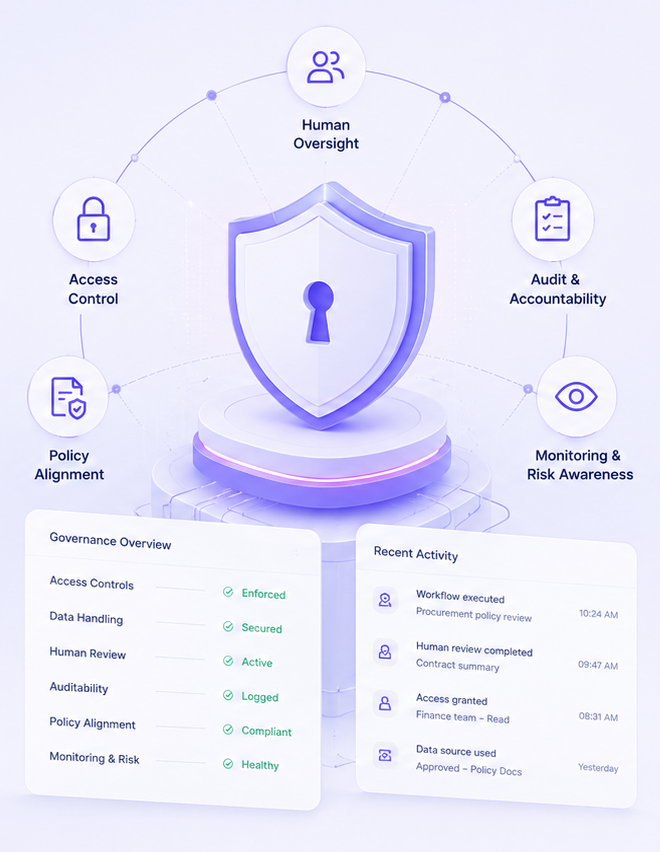
Enterprise AI should strengthen decision-making without weakening control, accountability or data protection. We help organisations design AI with practical safeguards, user roles and review checkpoints.
AI copilots support teams. Governance, approval and accountability remain with the organisation.
We help organisations apply AI where workflows, data and decision-making intersect—not as isolated experiments, but as business-ready capabilities.
Detailed case examples can be tailored to your industry, workflows and systems.
Our approach is workflow-led, which means AI solutions can be tailored to sector-specific operations, information flows and decision-making needs.
We deliver practical AI solutions that integrate with your systems, support your teams and drive measurable business outcomes.
Automate approvals, reporting, data processing, document handling and recurring operational workflows.
Build secure AI-powered knowledge environments that help teams search documents, policies, records and business systems using natural language.
Deploy task-oriented AI assistants that support teams in operations, recruitment, sales, finance, customer service and administration.
Operationalise Google Gemini across enterprise workflows, Google Workspace and internal processes while considering access controls, data handling and user adoption.
Generate summaries, reports, dashboards and operational insights from connected business data.
Design and develop AI-enabled platforms around specific business workflows, operational models and industry requirements.
“Automate company processes such as customer handling via chatbots and sales via AI-driven platforms to drive growth and efficiency. Deploy actionable insights coupled with AI automation and analytics to make complete use of our unique strategy to scale your business.”
Enterprise AI solutions apply artificial intelligence to real business workflows, systems, data and decision-making processes. Unlike standalone AI tools, they are designed to integrate with existing operations, support multiple teams and work within defined security, governance and approval controls.
Enterprise AI can automate repetitive work, accelerate reporting, improve knowledge access, support customer and employee workflows, identify exceptions and provide better operational visibility. The objective is to reduce manual dependency while helping teams make faster and more informed decisions.
AI can support approvals, document processing, data extraction, recurring reporting, customer enquiries, recruitment coordination, finance exception monitoring, knowledge search and other repeatable operational workflows. The suitability of each workflow depends on business value, data availability, risk and implementation effort.
Yes. Enterprise AI solutions can be connected with CRM platforms, ERP systems, document repositories, data warehouses, collaboration tools and internal applications. The integration approach depends on available APIs, data structures, access permissions and the workflow being supported.
An AI knowledge platform helps employees search and retrieve information from documents, policies, records and business systems using natural-language questions. It can reduce time spent searching across disconnected sources while maintaining controlled access to approved information.
An AI copilot assists users by generating summaries, recommendations, drafts or workflow guidance. An AI agent may perform defined actions across connected systems within approved boundaries. In both cases, governance, approval and accountability remain with the organisation.
Timelines vary according to the use case, number of integrations, data readiness and governance requirements. A focused pilot may take several weeks, while a broader enterprise implementation can require multiple phases covering discovery, design, development, validation and scaling.
This depends on the selected AI platform, service configuration and contractual terms. Enterprise implementations should use appropriate privacy settings, access controls, approved data pathways and vendor configurations to prevent unintended use or exposure of business information.
We assess business objectives, workflow friction, data availability, technical feasibility, implementation risk and expected value. Use cases are then prioritised according to their potential impact, complexity and suitability for practical deployment.
Yes. Gemini can be operationalised across Google Workspace and selected enterprise workflows for document assistance, email support, meeting summaries, research, reporting and knowledge access. Implementation should also consider user permissions, data handling, adoption and appropriate human review.
Security and governance are considered throughout the delivery process. This can include role-based access, approved data sources, human review checkpoints, audit trails, policy alignment, output monitoring and controls over the actions an AI system is permitted to perform.
Our approach is designed to support teams rather than remove organisational accountability. AI can reduce repetitive administrative work, improve access to information and assist decision-making, while employees continue to provide judgement, approval, context and oversight.
In many cases, yes. Some use cases can begin with documents, structured records or selected system data rather than a large centralised dataset. During discovery, we assess data quality, availability and access to determine what can be implemented reliably.
Success measures depend on the workflow and may include reduced processing time, lower manual effort, faster reporting, improved response times, better information retrieval, fewer exceptions, increased adoption and measurable improvements in operational performance.
Yes. A successful pilot can be expanded to additional teams, processes or business units after validating accuracy, usability, integration reliability, governance and measurable value. Scaling is usually performed in controlled phases rather than through a single organisation-wide rollout.
The consultation covers your business objectives, current workflows, systems, data sources, operational challenges and potential AI opportunities. The purpose is to identify practical next steps and determine whether a pilot, assessment or broader implementation roadmap is appropriate.
Start with a clearly defined operational problem rather than a general request to “implement AI.” Select a workflow where delays, repetitive work, fragmented information or limited visibility create measurable business impact, then assess feasibility, controls and expected outcomes before development begins.
Enterprise AI can support manufacturing, healthcare, financial services, real estate, professional services, recruitment, education, retail and distribution. The solution should be adapted to the workflows, information requirements and governance expectations of each sector.
Access essential resources to understand our capabilities, explore real-world impact, and take the next step in your AI transformation journey.
Let’s discuss how we can apply AI in your organisation—safely, practically and with measurable impact.
If you got any questions, please do not hesitate to send us a message.
Thank you! We will get back to you soon.
